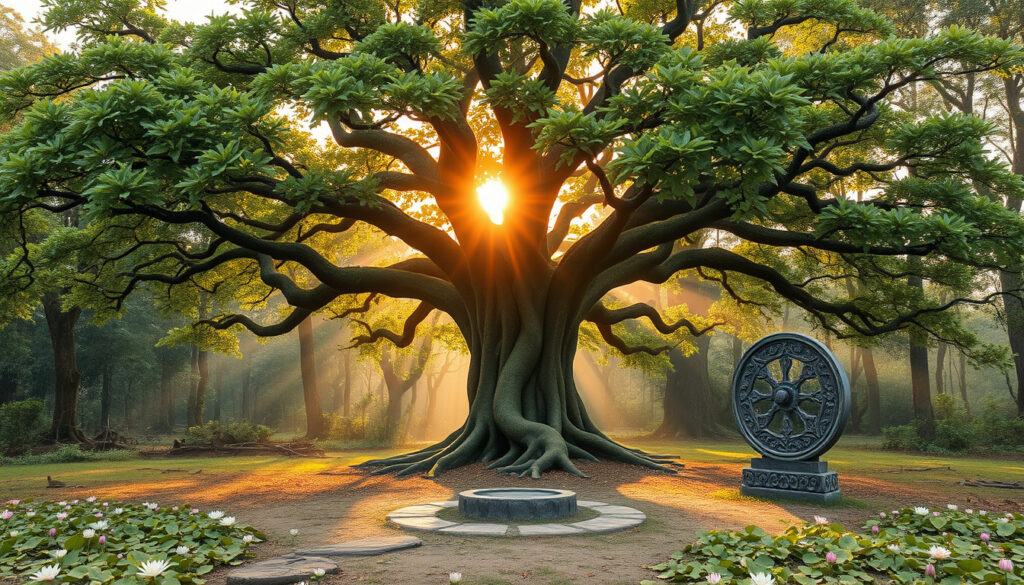
Gautama Buddha – Life, Teachings and Historical Facts
Gautama Buddha, the founder of Buddhism, is one of the most influential figures in human history. His life story—from a sheltered prince to an enlightened teacher—has inspired billions. This article separates historical fact from legend, explores his core teachings, and answers the most common questions about his life and legacy.
Siddhartha Gautama, known as the Buddha (“the awakened one”), is traditionally said to have been born in Lumbini (now in Nepal), attained enlightenment at Bodh Gaya, and died at Kushinagar after about 80 years of life. His life story centers on renunciation, meditation, awakening, and teaching a path to end suffering.
Who Was Gautama Buddha? The Historical Figure Behind the Title
Gautama Buddha was a historical figure, not a god, who lived and taught in ancient India. His life story follows a classic arc: from sheltered prince to spiritual seeker to enlightened teacher. The exact dates of his birth and death are uncertain, with scholars generally placing them between the 6th and 4th centuries BCE.
Full Name
Siddhartha Gautama
Lived
c. 563 BCE – c. 483 BCE (traditional)
Birthplace
Lumbini (present-day Nepal)
Known For
Founding Buddhism, achieving enlightenment
Key Insights
- Gautama Buddha was a historical figure, not a god, who lived and taught in ancient India.
- His life story follows a classic arc: from sheltered prince to spiritual seeker to enlightened teacher.
- The exact dates of his birth and death are uncertain, with scholars generally placing them between the 6th and 4th centuries BCE.
- His core teachings, including the Four Noble Truths and the Eightfold Path, form the foundation of Buddhism.
- No contemporary images or “real photos” of the Buddha exist; all depictions are artistic interpretations created centuries after his death.
Gautama Buddha: Key Facts at a Glance
| Attribute | Value |
|---|---|
| Birth Name | Siddhartha Gautama |
| Title | The Buddha (The Awakened One) |
| Born | c. 563 BCE, Lumbini, Nepal |
| Died | c. 483 BCE, Kushinagar, India |
| Spouse | Princess Yasodhara |
| Children | Rahula (son) |
| Key Event | Enlightenment under the Bodhi tree (c. 528 BCE) |
| Core Teachings | Four Noble Truths, Eightfold Path |
When Was Gautama Buddha Born and Died? A Timeline of His Life
Buddhist tradition places his birth in Lumbini, to a Shakya royal family. Sources differ on the exact date, but many traditional accounts place it around the 6th to 5th century BCE. Britannica notes uncertainty about the exact historical date of his death, with scholarly views ranging mainly around about 480 BCE to possibly a century later.
Timeline of Gautama Buddha’s Life
- c. 563 BCE: Birth as Prince Siddhartha Gautama in Lumbini.
- c. 547 BCE: The Four Sights: Siddhartha encounters old age, sickness, death, and a wandering ascetic.
- c. 537 BCE: The Great Renunciation: Siddhartha leaves the palace to become a wandering ascetic.
- c. 528 BCE: Attains enlightenment under the Bodhi tree in Bodh Gaya, becoming the Buddha.
- c. 528 BCE: Delivers his first sermon at Sarnath, setting the “Wheel of Dharma” in motion.
- c. 483 BCE: Passes away (Parinirvana) at Kushinagar.
What Is the Story of Gautama Buddha? From Prince to Enlightened Teacher
He was raised in luxury as a prince or noble of the Shakya clan, and tradition says his father tried to shelter him from suffering. According to tradition, he saw an old person, a sick person, a corpse, and a wandering ascetic, which prompted his search for liberation from suffering.
He left palace life in his late twenties to seek a solution to human suffering through spiritual practice. After renouncing luxury, he practiced severe asceticism and meditation for years, but later rejected extreme self-denial as ineffective. He attained awakening while meditating beneath the Bodhi tree at Bodh Gaya after confronting Mara, becoming the Buddha.
The Buddha’s path rejects both indulgence and extreme asceticism in favor of balanced practice. This principle, known as the Middle Way, became a cornerstone of his teachings.
Who Was Gautama Buddha’s Wife and Family?
Gautama Buddha was married to Princess Yasodhara. According to tradition, they had a son named Rahula. The Buddha left his family as part of his renunciation, but later returned to teach them. Both Yasodhara and Rahula eventually became his disciples and joined the monastic community.
What Are the Most Famous Gautama Buddha Quotes and Teachings?
Core Teachings
The Buddha’s core teachings include the Four Noble Truths: suffering exists; suffering has a cause; suffering can end; and there is a path leading to the end of suffering. The Noble Eightfold Path is the practical path to liberation, usually summarized as right understanding, intention, speech, action, livelihood, effort, mindfulness, and concentration.
Buddhist tradition presents the Buddha as teaching that clinging to impermanent things causes suffering. His teachings emphasize training the mind, ethical conduct, and wisdom as the route to awakening.
Notable Quotes
“All that we are is the result of what we have thought.”
— Dhammapada (attributed to the Buddha)
“The mind is everything. What you think you become.”
— Dhammapada (attributed to the Buddha)
“Three things cannot be long hidden: the sun, the moon, and the truth.”
— Dhammapada (attributed to the Buddha)
The earliest collection of Buddhist scriptures is the Pali Canon (Tripitaka). The Dhammapada is a collection of sayings of the Buddha in verse form. The Jataka Tales are stories of the Buddha’s previous lives.
Is There a Real Photo of Gautama Buddha?
No contemporary images or “real photos” of the Buddha exist. All depictions are artistic interpretations created centuries after his death. The earliest surviving biographies were written down after centuries of oral transmission. The oldest images of the Buddha date from several centuries after his death and are artistic representations, not portraits.
What We Know vs. What Is Uncertain
| Established Information | Information That Remains Unclear |
|---|---|
| Gautama Buddha was a historical figure who lived in ancient India. | The exact years of his birth and death are debated; traditional dates (563-483 BCE) are not universally accepted by historians. |
| He was born as a prince in Lumbini and later renounced his life of luxury. | Many details of his life story are interwoven with legend and symbolism, making it difficult to separate historical fact from religious narrative. |
| He achieved enlightenment and spent the rest of his life teaching. | No contemporary written records from his lifetime exist; the earliest accounts were written down centuries after his death. |
| His teachings form the basis of Buddhism. | The precise dates and many details of the life story remain debated. |
Historical and Cultural Context
Gautama Buddha lived during a period of significant religious and philosophical ferment in ancient India, known as the “Second Urbanization” (c. 600-200 BCE). This era saw the rise of new ideas that challenged the established Vedic religion and its caste system. The Buddha’s teachings, which emphasized personal spiritual practice, ethical conduct, and the rejection of ritual sacrifice, were part of a broader “Śramaṇa” movement that included other teachers like Mahavira (founder of Jainism).
Understanding this context is crucial for appreciating why the Buddha’s message resonated so strongly and how it differed from the prevailing beliefs of his time. His life is associated with regions in present-day Nepal and India, especially Lumbini, Bodh Gaya, Sarnath, and Kushinagar.
Sources and Credibility
The broad outline of his life is consistent across major references: birth in Lumbini, renunciation, enlightenment at Bodh Gaya, teaching ministry, and death in Kushinagar. However, the precise dates and many details of the life story remain debated, because the earliest surviving biographies were written down after centuries of oral transmission.
Reputable sources include academic encyclopedias (Britannica, Stanford Encyclopedia of Philosophy), the Wikipedia article on “The Buddha”, and publications from Buddhist studies scholars. Always cross-reference information from multiple authoritative sources.
Summary: The Enduring Legacy of Gautama Buddha
Gautama Buddha was a historical figure who achieved enlightenment and founded Buddhism. His teachings on suffering, impermanence, and the path to liberation continue to influence millions worldwide. While many details of his life remain uncertain, his core message of compassion, mindfulness, and ethical living remains as relevant today as it was 2,500 years ago. For more on other influential historical figures, explore the biography of Mark Twain – Biography, Famous Works, and Controversy. Readers interested in philosophical parallels may also find value in this guide to Stoicism and its core tenets.
Frequently Asked Questions
What is the best book about Gautama Buddha?
For a comprehensive biography, “Buddha: A Story of Enlightenment” by Deepak Chopra is popular. For a more scholarly approach, “The Buddha: A Short Biography” by John S. Strong is excellent. The Dhammapada itself is a foundational text.
What is the difference between Siddhartha Gautama and the Buddha?
Siddhartha Gautama was the birth name of the historical figure. “Buddha” is a title meaning “the Awakened One,” which he earned after achieving enlightenment. So, Siddhartha Gautama became the Buddha.
Was Buddha a god?
No. The Buddha was a human being who achieved a state of profound spiritual awakening through his own efforts. He is not considered a god in Buddhism, but rather an enlightened teacher whose path others can follow.
Where can I find reliable information about the Buddha?
Reputable sources include academic encyclopedias (Britannica, Stanford Encyclopedia of Philosophy), the Wikipedia article on “The Buddha”, and publications from Buddhist studies scholars. Always cross-reference information from multiple authoritative sources.
Did Gautama Buddha have children?
Yes, according to tradition, he had a son named Rahula with his wife Princess Yasodhara. Rahula later became a disciple of the Buddha.
What did Gautama Buddha look like?
No contemporary images exist. All depictions are artistic interpretations created centuries after his death. The oldest images of the Buddha date from several centuries after his death.
Where was Gautama Buddha born?
Buddhist tradition places his birth in Lumbini, which is in present-day Nepal. It is a UNESCO World Heritage site.
How did Gautama Buddha become enlightened?
He attained awakening while meditating beneath the Bodhi tree at Bodh Gaya after confronting Mara, the embodiment of temptation and distraction.
What are the Four Noble Truths?
The Four Noble Truths state: suffering exists; suffering has a cause; suffering can end; and there is a path leading to the end of suffering. This path is the Noble Eightfold Path.
What is the Noble Eightfold Path?
The Noble Eightfold Path is the practical path to liberation in Buddhism, usually summarized as right understanding, intention, speech, action, livelihood, effort, mindfulness, and concentration.
More related posts
 Joe Strummer – Biography, Cause of Death, Net Worth and Quotes
 DWP Bank Account Checks 2026 – What You Need to Know
 Pull and Bear Discount Code – 10% Student Deals UK
 Wordle Today New York Times – Hints for Puzzle #1768 April 22
 Emily Armstrong – Age, Linkin Park, Dead Sara and Controversy
 Sunda Energy Share Price – Analysis, Forecasts and Key Facts
 Astronomer CEO Andy Byron – Coldplay Incident and Resignation