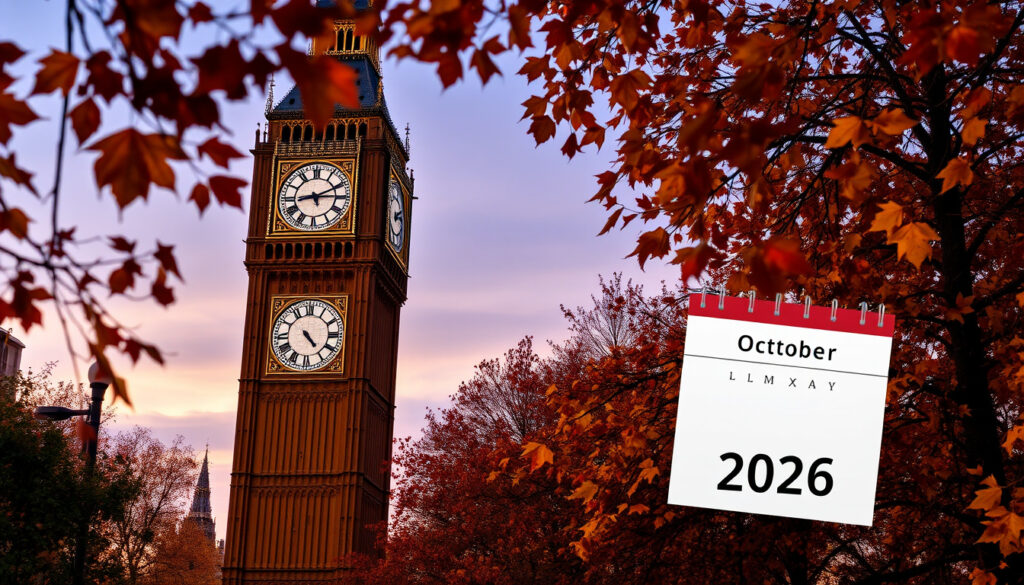
When Do the Clocks Go Back – 2026 UK Date and History
The end of British Summer Time is a fixed point in the UK calendar. On the last Sunday of October, the clocks go back, marking the transition to Greenwich Mean Time (GMT). For 2026, the date is set, and the rules that govern the change remain consistent with those established over a century ago.
That means at 2:00am on Sunday 25 October 2026, the time will shift back to 1:00am GMT. This provides one extra hour of daylight in the morning, but evenings become darker earlier.
When do the clocks go back in the UK?
- The clocks always go back on the last Sunday of October (UK rule).
- The change at 2:00am minimizes disruption (fewer public transport services operate at that hour).
- Daylight Saving Time was widely adopted during the First World War to conserve fuel, not for farmers.
- Farmers often oppose DST because livestock schedules do not change with the clock.
| Fact | Detail |
|---|---|
| Next clock back | 25 October 2026 |
| Time of change | 02:00 → 01:00 |
| Resulting time zone | Greenwich Mean Time (GMT) |
| Duration of BST | Last Sunday March to last Sunday October |
| First DST in UK | 1916 (Summer Time Act) |
Do the clocks go forward or back in October?
In October, the clocks go back by one hour. This is the autumn change that ends British Summer Time. The opposite occurs in March, when clocks go forward to begin BST. A common memory aid is “spring forward, fall back.”
When do the clocks go forward?
In 2026, clocks go forward on Sunday 29 March. That change shifts daylight from the morning into the evening. The two dates — 29 March and 25 October — are fixed relative to the last Sunday in their respective months, but the specific calendar date moves each year.
What about “spring forward, fall back”?
The phrase is a simple memory trick used in the UK and many other countries that observe daylight saving. “Spring forward” refers to setting clocks ahead one hour in March. “Fall back” refers to setting clocks back one hour in October.
Many people ask whether the clocks go forward or back in October. The answer is always “back” — turning them backward means you gain an hour, but evenings get darker earlier. The shift happens at 2:00am, a time chosen to cause minimal disruption.
Why do the clocks go back?
The basic reason is to make better use of daylight during the winter months. GMT, the standard time, is the baseline. In summer, the UK switches to BST, which is one hour ahead, to shift daylight toward the evening. In autumn, the return to GMT shifts daylight back toward the morning.
The role of farmers – myth or fact?
A widely repeated story claims that the clock change was introduced to help farmers. This is not accurate. The Summer Time Act 1916 was introduced during the First World War primarily to conserve coal and energy.
In reality, farmers were not consulted, and the change can create practical difficulties for agriculture. Livestock, for example, does not adjust its schedule based on an artificial time change. The myth appears to have arisen because agricultural patterns are tied to daylight, so the practice affected farmers — but it was not designed for them.
History of BST and GMT
The idea for daylight saving was promoted in Britain by William Willett, who argued in 1907 for “saving daylight.” His proposal eventually led to the Summer Time Act 1916. During the Second World War, the UK used British Double Summer Time for periods, setting clocks two hours ahead of GMT. A trial under the Harold Wilson government from 1968 to 1971 kept clocks forward year-round, but it was not adopted permanently.
The Summer Time Act 1916 introduced British Summer Time during the First World War. The primary motivation was to make better use of daylight and help conserve coal, which was a critical wartime resource.
Key dates for UK clock changes – 2025 and beyond
For 2026, the dates are confirmed. On 29 March, clocks go forward at 1:00am. On 25 October, they go back at 2:00am. After 25 October, the next change will be on 28 March 2027.
Clock change dates for 2025
In 2025, the clocks went forward on 30 March and back on 26 October. No legislative changes to abolish DST in the UK are currently scheduled for 2025 or 2026.
Clock change dates for 2026
- Clocks go forward: Sunday 29 March 2026
- Clocks go back: Sunday 25 October 2026
The EU has debated abolishing seasonal clock changes, but the UK is not part of the EU and has not proposed any change to its own rules. For now, the last-Sunday-in-October rule remains fixed. The dates for 2027 will follow the same pattern.
History of UK Clock Changes
- 1916: Summer Time Act introduces daylight saving in the UK.
- 1968-1971: Experimental year-round BST (clocks not put back during winter) under the Harold Wilson government.
- 2026 (March 29): Clocks go forward to BST.
- 2026 (October 25): Clocks go back to GMT.
- Future: EU proposal to abolish seasonal changes — UK position unchanged.
What is confirmed and what remains uncertain?
The rules for 2026 are fully established. The timing and direction are based on a fixed formula that does not change from year to year.
| Established information | Information that remains unclear |
|---|---|
| UK clocks go back on last Sunday of October at 2am (fixed rule). | Possible future abolition of DST in UK (government has not changed the rule). |
| Next date is 25 October 2026 (confirmed by gov.uk and Royal Museums Greenwich). | EU countries may shift their approach, but UK is not in the EU. |
| BST ends and GMT resumes. | No definitive decision on permanent BST for the UK exists. |
What is the background and meaning of the clock change?
The UK observes British Summer Time from March to October to extend evening daylight. The “fall back” in October returns the UK to GMT. The practice dates to 1916 and is based on a proposal by William Willett. The common myth that it helps farmers is largely incorrect — farming schedules are based on daylight, not clock time. The system was designed for energy conservation during wartime.
Who sets these dates and where can you verify them?
“In the UK the clocks go forward 1 hour at 1am on the last Sunday in March, and back 1 hour at 2am on the last Sunday in October.”
“The clocks will go back in the UK on Sunday 25 October 2026 at 2am.”
“BST will end this year on 25 October when clocks in the UK ‘fall back’ from 02:00 to 01:00.”
You can also verify dates through the RAC and the National Maritime Museum for historical context.
What happens next?
After the clocks go back on 25 October 2026, the UK will remain on GMT until the last Sunday of March 2027. That next change occurs on 28 March 2027, when clocks go forward again. The seasonal rhythm continues unchanged, with no legislative action currently pending to alter the system. Meanwhile, the autumn months also bring seasonal weather patterns; you can read more about an Indian Summer UK weather forecast. As winter approaches, many travelers also look ahead to Christmas markets Europe 2025.
Frequently asked questions
Do the clocks go forward tonight?
The clocks go back in October, not forward. Tonight (in October) they go back at 2am. In March they go forward.
Why do the clocks go back farmers?
Contrary to popular belief, the practice was not introduced for farmers. Agriculture often opposes DST because animals follow natural sunlight. The myth persists because farmers were affected, but the primary reason was energy saving during WWI.
When do the clocks go forward?
In the UK, clocks go forward on the last Sunday of March (next: 29 March 2026).
What is the difference between GMT and BST?
GMT (Greenwich Mean Time) is the standard time during winter. BST (British Summer Time) is GMT+1, used from March to October.
When do the clocks change?
Twice a year: last Sunday of March (forward) and last Sunday of October (back).
At what time do the clocks go back?
At 2:00am. The clocks are turned back to 1:00am GMT.
Why is the change at 2am?
2am was chosen to minimize disruption because few trains and public services operate at that time.
Does the change affect my smartphone?
Yes, most modern devices connected to the internet adjust automatically. Analogue clocks and older devices need manual setting.
More related posts
 Thomas Skinner – Biography, Net Worth, Family and Career
 Jeff Baena – Life, Career, and Tragic Death
 Stacey Solomon – Biography, Net Worth, Family and TV Career
 Yasmine Akram – Biography, Career, Age, and Personal Life
 How to Make Custard – Step-by-Step Guide and Fixes
 How to Draw Stitch – Step-by-Step Beginner Guide
 Tom Stoppard – His Life, Death and Lasting Legacy
 Aston Villa vs PSG Stats – Full Stats, Lineups and Match Analysis