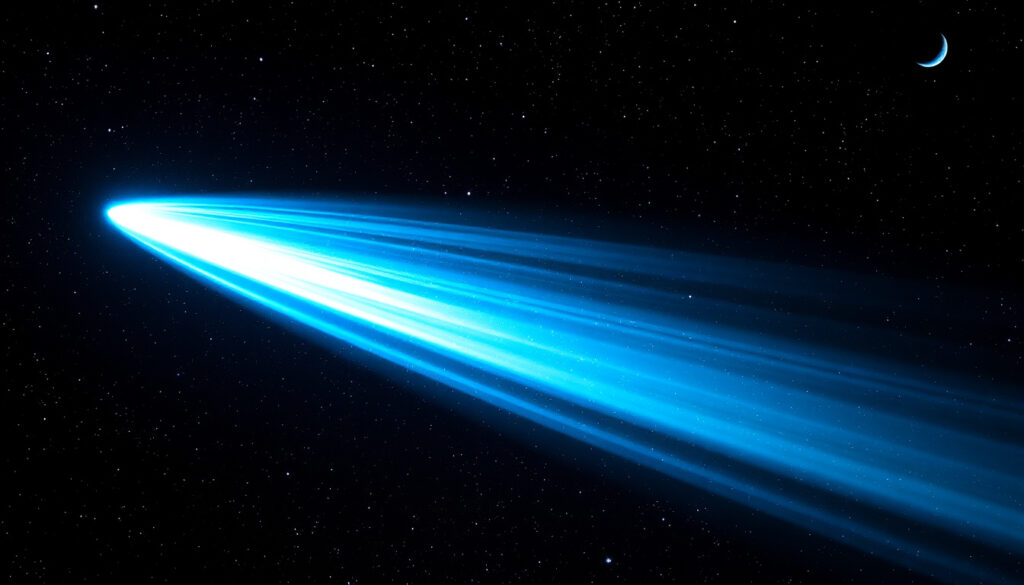
NASA Interstellar Comet 3I/ATLAS – Live Tracker and Latest Observations
A visitor from beyond our solar system is racing through the inner planets. Interstellar comet 3I/ATLAS, only the third known object of its kind, has been closely monitored by NASA and its partners since its discovery in July 2025. Here is a complete overview of what scientists have learned so far.
What Is Interstellar Comet 3I/ATLAS?
Designated 3I/ATLAS — also written as C/2025 N1 (ATLAS) and formerly A11pl3Z — this object is classified as interstellar because its orbit is hyperbolic and unbound. That means it is not circling the Sun in a closed ellipse. As NASA explains, tracing its path backward shows it originated outside our solar system.
At the time of discovery, the comet was moving at roughly 137,000 mph (221,000 km/h), or about 61 km/s. It is only the third confirmed interstellar object, following 1I/‘Oumuamua (2017) and 2I/Borisov (2019).
Key Insights at a Glance
- 3I/ATLAS is only the third known interstellar object ever detected.
- It was observed by NASA’s James Webb Space Telescope and SPHEREx, which revealed water ice and carbon dioxide.
- The comet made its closest approach to Earth on December 19, 2025.
- Scientific consensus confirms it is a natural comet, not an alien spacecraft.
- Live tracking data is available through NASA’s Eyes on the Solar System tool.
- Hubble observations placed its nucleus diameter between 1,400 feet (440 m) and 3.5 miles (5.6 km).
- NASA states unequivocally that the object poses no threat to Earth.
Snapshot Facts
| Fact | Details |
|---|---|
| Designation | 3I/ATLAS |
| Object type | Interstellar comet (icy body) |
| Number of known interstellar objects | Third (after 1I/‘Oumuamua and 2I/Borisov) |
| Discovery | Detected by the ATLAS survey on July 1, 2025 |
| Closest approach to Earth | December 19, 2025 |
| Observed by | NASA (Webb, SPHEREx, Hubble), ESA, ground-based telescopes |
| Key detected compounds | Water ice, carbon dioxide |
| Current trajectory | Exiting the solar system after closest approach |
Where Is 3I/ATLAS Now and How Can I Track It?
After its closest approach to Earth on December 19, 2025, the comet has been moving away from our planet. NASA reports that 3I/ATLAS remained visible to ground-based telescopes through September 2025, then passed too close to the Sun for Earth-based observation before reappearing by early December 2025.
A practical way to follow the comet’s position is NASA’s Eyes on the Solar System, an interactive 3D visualization tool that includes a Distance Tool for tracking the separation between 3I/ATLAS and other bodies. Space.com also hosted a free webcast for the December 19 close approach.
NASA’s Eyes on the Solar System provides a live trajectory visualization for 3I/ATLAS. Users can view the comet’s current position relative to planets and use the built-in Distance Tool to measure how far it is from Earth at any given time.
Current Distance and Path
During its closest approach to Earth, 3I/ATLAS came no nearer than about 1.8 AU — roughly 170 million miles or 270 million km. That is well beyond the orbit of Mars, meaning the comet never posed any impact risk. Its orbit is hyperbolic, so it will continue on a one-way path out of the solar system.
Map and Orbit Visualization
The comet’s trajectory brings it from interstellar space inward past the orbit of Jupiter, then inside Mars’s orbit at perihelion, and back outward. Pre-discovery observations from the ATLAS archives and Caltech’s Zwicky Transient Facility extended the known observation arc back to June 14, 2025, giving scientists a clearer view of its inbound path.
What Have NASA and Other Observatories Observed About 3I/ATLAS?
An intensive observation campaign has been underway since the comet’s discovery. Multiple space-based observatories and ground telescopes have collected data on its size, composition, and behavior.
James Webb Space Telescope Observations
The James Webb Space Telescope observed 3I/ATLAS on August 6, 2025, using its Near-Infrared Spectrograph. According to the European Space Agency, Webb’s data help determine the comet’s size, physical properties, and chemical composition. A preprint of the team’s analysis has been made available.
SPHEREx and Carbon Dioxide Detection
NASA’s SPHEREx mission observed the comet in mid-August 2025 and detected an unusually extensive carbon dioxide gas coma extending at least 348,000 km in radius — a significant finding that sheds light on the comet’s volatile content.
SPHEREx identified a carbon dioxide coma around 3I/ATLAS spanning at least 348,000 km in radius. Combined with water ice detected by Webb, the data confirm the object is a typical icy comet, not a rocky or metallic body.
Hubble Size Estimates
Hubble observations on August 20, 2025, were used to estimate the nucleus diameter. NASA reports the size at not less than 1,400 feet (440 m) and not greater than 3.5 miles (5.6 km). That places it in a comparable range to many solar-system comets.
Additional Observations
The comet also made a close pass by Mars in early October 2025, and spacecraft operating in the vicinity of Mars were positioned to observe it. Multiple NASA missions across the solar system participated in the campaign, including Hubble, Webb, and SPHEREx.
Is 3I/ATLAS an Alien Spacecraft?
Online speculation has occasionally suggested that 3I/ATLAS might be of artificial origin. The available evidence does not support that claim.
NASA and ESA consistently describe 3I/ATLAS as a comet with standard astronomical characteristics — a coma, gas emissions, and a measurable nucleus size consistent with a natural icy body. The hyperbolic trajectory that makes it interstellar is purely gravitational. No unusual activity or artificial signatures have been reported in any peer-reviewed or official source.
Claims that 3I/ATLAS is an alien spacecraft are internet conjecture, not a conclusion supported by NASA or ESA. Both agencies classify the object as a natural interstellar comet based on its composition, behavior, and orbit.
The same kind of speculation arose around 1I/‘Oumuamua in 2017, but subsequent analysis of both objects has consistently pointed to natural origins. As ESA notes, the comet exhibits outgassing and a coma — hallmarks of an icy body warmed by the Sun.
When Did 3I/ATLAS Make Its Closest Approach to Earth?
The key dates for 3I/ATLAS span its discovery through its closest passes by the Sun and Earth. Here is the sequence of major events.
- June 14, 2025 — Pre-discovery observations recorded by the ATLAS survey and the Zwicky Transient Facility.
- July 1, 2025 — Official discovery by the ATLAS survey telescope in Rio Hurtado, Chile. The comet was then about 410 million miles (670 million km) from the Sun, within Jupiter’s orbit.
- August 6, 2025 — James Webb Space Telescope observations using the Near-Infrared Spectrograph.
- Mid-August 2025 — SPHEREx detects an extensive carbon dioxide coma.
- August 20, 2025 — Hubble observations provide nucleus size estimates.
- Early October 2025 — Close pass by Mars; spacecraft around Mars conduct observations.
- October 29–30, 2025 — Perihelion (closest approach to the Sun) at about 1.4 AU (roughly 210 million km), just inside Mars’s orbit. (NASA gives October 30 at 1.4 AU; Wikipedia gives October 29 at 1.36 AU — a rounding difference.)
- December 19, 2025 — Closest approach to Earth at about 1.8 AU (roughly 170 million miles / 270 million km). No impact risk.
What Is the Latest Update on 3I/ATLAS?
As the comet moves away from the inner solar system, ongoing analysis of data collected during the 2025 observation campaign continues. Here is what is well established and what remains uncertain.
| Established Information | Information That Remains Unclear |
|---|---|
| 3I/ATLAS is an interstellar object (proven by hyperbolic orbit). | Exact size and shape are still being refined. |
| It is a comet (shows typical outgassing and coma). | The origin star system or region cannot be determined from current data. |
| It is not of artificial origin (natural composition, no unusual activity). | Full composition remains limited to available spectral data. |
| Water ice and CO2 have been detected. | Whether it carries organic molecules is not yet known. |
| No threat to Earth (closest approach was 1.8 AU). | — |
How Does 3I/ATLAS Compare to Other Interstellar Objects?
3I/ATLAS is the third known interstellar object, and each has offered unique insights. 1I/‘Oumuamua, discovered in 2017, had an elongated shape and no visible coma, which fueled speculation about its nature. 2I/Borisov, found in 2019, was clearly a comet with a coma and tail, closely resembling solar-system comets.
3I/ATLAS is also a comet, but it has been observed with far more advanced facilities than its predecessors. Telescopes like the James Webb Space Telescope and SPHEREx were able to study its composition in detail, revealing water ice and carbon dioxide. The implication is that interstellar comets may be common, and the solar system is part of a broader galactic population of such objects.
Each new discovery provides data to help astronomers understand the composition and prevalence of material from other star systems. For a broader look at these visitors, see our guide to interstellar objects.
What Do Official Sources Say About 3I/ATLAS?
“Comet 3I/ATLAS is the third known object from outside our solar system to be discovered passing through our celestial neighborhood.”
— NASA
“Comet 3I/ATLAS is an interstellar object, meaning that it comes from outside our Solar System.”
— European Space Agency
“Comet 3I/ATLAS, only the third known interstellar visitor, passes closest to Earth on Friday, Dec. 19.”
— Space.com
“NASA’s SPHEREx and James Webb Space Telescope take a look at interstellar comet 3I/ATLAS, revealing water ice and carbon dioxide.”
— Sky at Night Magazine
What Is the Significance of 3I/ATLAS?
Interstellar comet 3I/ATLAS offers a rare opportunity to study material that formed around another star. Its passage through the inner solar system has been documented by the most powerful observatories ever built, yielding data on its size, composition, and behavior that will be analyzed for years. The comet poses no danger to Earth and is now on a permanent trajectory back into interstellar space. For the latest on this and other interstellar visitors, see our dedicated 3I/ATLAS resource page.
Frequently Asked Questions
How big is 3I/ATLAS?
Exact size has not been reported with precision. Hubble observations estimate the nucleus diameter between 1,400 feet (440 m) and 3.5 miles (5.6 km).
Who discovered 3I/ATLAS?
It was discovered by the ATLAS survey (Asteroid Terrestrial-impact Last Alert System), a NASA-funded early warning system for near-Earth objects, on July 1, 2025.
Is 3I/ATLAS dangerous to Earth?
No. Its orbit is hyperbolic and never came closer than about 1.8 AU (170 million miles) to Earth. NASA states it poses no threat.
Can I see 3I/ATLAS with a telescope?
Around its closest approach in December 2025, it was within reach of amateur telescopes with moderate apertures (8 inches or larger) under dark skies. It is now fading as it moves away.
Will 3I/ATLAS return?
No. Its hyperbolic trajectory means it will leave the solar system permanently and not return.
How fast was 3I/ATLAS traveling at discovery?
NASA reports it was moving at about 137,000 mph (221,000 km/h), or roughly 61 km/s, at the time of discovery.
What compounds have been detected on 3I/ATLAS?
Water ice and carbon dioxide have been detected. SPHEREx observed an extensive CO2 coma, and Webb confirmed water ice.
Why is it called 3I/ATLAS?
The “3I” stands for the third interstellar object. “ATLAS” denotes the survey that discovered it. It is also cataloged as C/2025 N1 (ATLAS).
More related posts
 Woody Allen – Biography, Net Worth 2025 and Best Movies
 Carl Thomas Dean – Dolly Parton’s Husband Dies at 82
 Eddie Munson – Complete Character Guide for 2025
 Audrey Tautou – Biography, Movies and Private Life in 2025
 Dianne Buswell – Strictly Come Dancing Winner and New Mum
 FIFA World Cup Games – 2026 Schedule and Groups Guide
 Vodafone Broadband Contact Number – UK Helplines Hours and Tips