Isaac Newton – Biography, Laws of Motion, and Legacy
Sir Isaac Newton transformed the way humanity understands the physical world. His three laws of motion and law of universal gravitation laid the foundation for classical mechanics, while his independent development of calculus and pioneering work in optics reshaped mathematics and physics. Born in 1642 in rural England, Newton lived through an era of profound scientific change and left a legacy that continues to influence modern science.
Newton’s life was marked by intense intellectual focus, long periods of solitary work, and a deep curiosity that extended far beyond what is now considered mainstream science. He was a mathematician, physicist, astronomer, theologian, and alchemist. His work unified the motion of planets with the fall of objects on Earth, a conceptual leap that few before him had imagined possible.
Despite his towering reputation, many aspects of Newton’s personal life remain less known. He never married, kept a small circle of close associates, and devoted much of his energy to pursuits that he kept largely private, including alchemy and biblical chronology. His story is one of brilliance, rivalry, and the relentless pursuit of knowledge.
What Is Isaac Newton’s Biography?
Born
25 December 1642, Woolsthorpe, England
Died
20 March 1727, London, England
Known for
Laws of motion, universal gravitation, calculus
Major work
Philosophiæ Naturalis Principia Mathematica (1687)
Key Insights About Isaac Newton
- Isaac Newton never married and had no known children.
- His apple-inspired theory of gravity is partly myth; he developed the idea over years.
- Newton’s calculus was developed concurrently but independently of Leibniz, sparking a priority dispute.
- He served as Master of the Royal Mint and was deeply interested in alchemy and biblical chronology.
- Newton’s death was due to natural causes after a period of illness; he was buried in Westminster Abbey.
Snapshot Facts About Isaac Newton
| Attribute | Detail |
|---|---|
| Full name | Sir Isaac Newton |
| Birth | 25 December 1642, Woolsthorpe, Lincolnshire, England |
| Death | 20 March 1727, Kensington, London, England |
| Education | Trinity College, Cambridge |
| Major contributions | Laws of motion, universal gravitation, calculus, reflecting telescope |
| Notable works | Principia Mathematica, Opticks |
| Positions held | Lucasian Professor, Warden & Master of the Royal Mint, President of the Royal Society |
| Awards | Knighted 1705 |
| Marital status | Never married |
What Did Isaac Newton Invent and Discover?
The Three Laws of Motion and Universal Gravitation
Newton’s most celebrated contribution to physics is the formulation of the Laws of motion, which remain the basic principles of modern mechanics. The first law, known as the law of inertia, states that an object remains at rest or in uniform motion unless acted upon by a force. The second law establishes that force equals mass times acceleration (F=ma). The third law declares that for every action, there is an equal and opposite reaction.
These laws led directly to his law of universal gravitation, which posits that every particle of matter in the universe attracts every other particle with a force that varies inversely with the square of the distance between them. This principle unified the motion of celestial bodies, such as the Moon, with the behavior of objects on Earth, such as an apple falling from a tree. The achievement represented the first great unification in physics, bringing together terrestrial and celestial mechanics under a single framework.
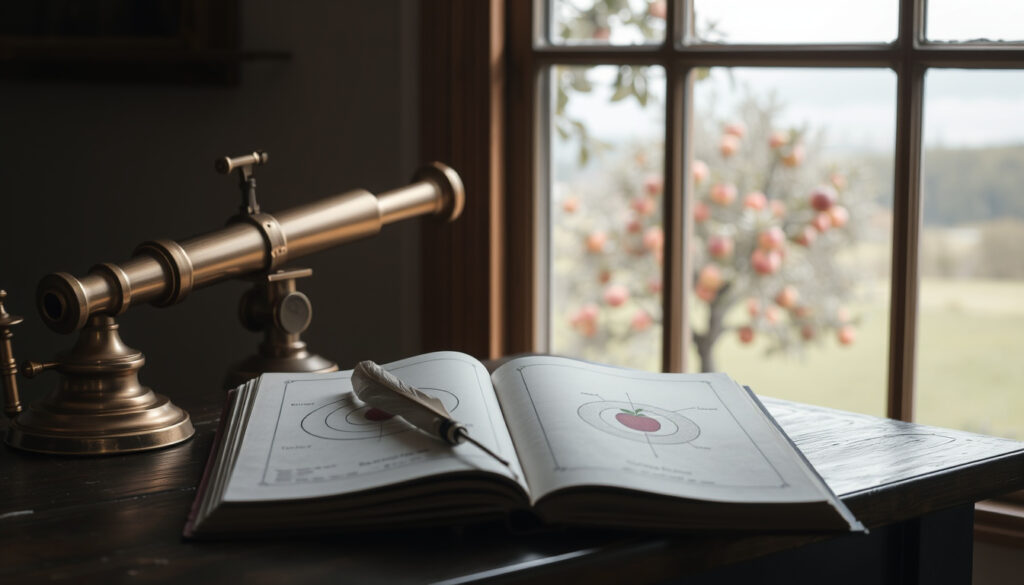
The popular tale that an apple fell on Newton’s head and instantly inspired his theory of gravity is a myth. According to well-known accounts, Newton saw an apple fall from a tree in his orchard at Woolsthorpe around 1665 or 1666. This observation led him to wonder why the apple fell straight down rather than at an angle, prompting him to realize that the same force governing the apple’s fall also governed the motion of the Moon around the Earth. The idea developed over years, not in a single moment.
Optics and the Nature of Light
In the field of optics, Newton passed sunlight through a prism and discovered that white light is composed of a heterogeneous spectrum of colors. This finding challenged the prevailing view that prisms somehow colored the light. He concluded that white light is a mixture of all colors, not a pure substance that becomes colored through refraction.
Based on this understanding, Newton invented the reflecting telescope, also known as the Newtonian telescope. By using mirrors instead of lenses, the design avoided chromatic aberration, a major flaw in earlier telescopes that produced colored fringes around images. This invention remains in use today in many amateur and professional telescopes.
Calculus: The Method of Fluxions
Newton laid the foundation for differential and integral calculus, which he called the method of fluxions, during the plague years of 1665 and 1666. He developed these mathematical tools to solve problems involving changing rates and areas. However, the work remained unpublished for over 30 years, a delay that would later have significant consequences.
Gottfried Leibniz independently developed and published a similar system of calculus, leading to a fierce and bitter priority dispute between the two mathematicians and their supporters. While Newton developed his method first, Leibniz published first, and the question of who deserves sole credit remains debated among historians of mathematics.
What Is Known About Isaac Newton’s Personal Life and Death?
Did Isaac Newton Have a Wife?
Isaac Newton never married and had no known children. Historical records indicate that he had a solitary temperament and maintained few close personal relationships. His emotional life centered largely on his intellectual work, and there is no evidence of any romantic attachments. Some biographers have speculated about his relationships with a few male friends, but no definitive conclusions have been reached.
Alchemy and Theological Pursuits
Beyond his scientific achievements, Newton was a devoted alchemist and theologian who spent significant time studying the occult and biblical prophecy. These works were largely unpublished during his lifetime, and only in recent decades have scholars given them serious attention. Newton wrote extensively on the interpretation of Scripture, the chronology of ancient kingdoms, and the nature of the divine. His religious views were unorthodox for his time; he rejected the doctrine of the Trinity and held to a form of Arianism.
Newton’s alchemical manuscripts, which number in the hundreds of thousands of words, reveal a thinker deeply engaged with the traditions of hermetic philosophy. He sought to understand the underlying principles of matter and transformation, pursuits that were not separate from his scientific work but rather part of a broader intellectual quest. His interest in alchemy was not unusual for a natural philosopher of the 17th century, but the scale of his dedication was extraordinary.
How Did Isaac Newton Die?
Newton died in London on 20 March 1727 according to the Julian calendar then in use (or 31 March 1727 in the New Style calendar), at the age of 84. He had been suffering from a painful illness in his final months, including kidney stones and other ailments. His death was attributed to natural causes. He was buried in Westminster Abbey, a rare honor that reflected his status as one of the most important figures in British history. His funeral was attended by many of the leading intellectuals and public figures of the day.
What Books Did Isaac Newton Write?
Philosophiæ Naturalis Principia Mathematica (1687)
The Principia, as it is commonly called, is regarded as the seminal work of modern science and the single most influential book on physics ever published. In it, Newton describes the laws of motion, orbital dynamics, tidal theory, and universal gravitation, achieving the first great unification in physics. The book was published at the expense of Edmond Halley, who corresponded with Newton and encouraged him to complete the manuscript. Halley’s role was crucial; without his financial support and persistence, the Principia might never have appeared in print.
The Principia is written in Latin and uses classical geometric methods rather than the calculus that Newton had developed. Many of Newton’s contemporaries found the work extremely difficult to read. Only a handful of scholars in Europe could fully understand it upon publication. Despite this, its arguments were so compelling that it quickly became the foundation of modern physics.
Opticks (1704)
Opticks is Newton’s major work on the nature of light and color. In it, he presents his theory that white light is composed of a spectrum of colors and describes experiments with prisms, lenses, and diffraction. The book was written in English rather than Latin, making it accessible to a broader audience. Although Newton’s optical theories had been introduced earlier in papers to the Royal Society, Opticks brought them together in a systematic form.
What Were the Key Events in Isaac Newton’s Life?
- 1642 – Born in Woolsthorpe, Lincolnshire.
- 1661 – Admitted to Trinity College, Cambridge.
- 1665–1666 – Annus Mirabilis: develops calculus, theories of light, and gravity.
- 1669 – Appointed Lucasian Professor of Mathematics.
- 1672 – Elected Fellow of the Royal Society.
- 1687 – Publishes Principia Mathematica.
- 1696 – Appointed Warden of the Royal Mint.
- 1703 – Elected President of the Royal Society.
- 1704 – Publishes Opticks.
- 1727 – Dies in London; buried in Westminster Abbey.
What Is Fact and What Remains Uncertain About Newton?
| Established Information | Information That Remains Unclear |
|---|---|
| Newton was born on 25 December 1642 (Julian calendar) in Woolsthorpe. | The exact moment of the apple falling is anecdotal; no contemporary record of the event exists. |
| He died on 20 March 1727 (OS) / 31 March 1727 (NS) in London. | Debate continues over whether Newton or Leibniz should be credited as the sole inventor of calculus. |
| He never married and had no children. | Newton’s religious and alchemical writings are less well-documented and often omitted from popular accounts. |
| He formulated the laws of motion and universal gravitation. | The full extent of his secret alchemical experiments remains a subject of ongoing research. |
| He invented the reflecting telescope and wrote the Principia Mathematica. | His personal relationships and private life are known only through fragmentary records. |
What Was Isaac Newton’s Place in the Scientific Revolution?
Newton’s work did not emerge in a vacuum. He built on the achievements of Copernicus, Kepler, and Galileo, synthesizing their insights into a coherent mathematical system that described both terrestrial and celestial motion. His mathematical methods, which he called fluxions, laid the groundwork for modern calculus and physics. The Scientific Revolution of the 17th century found its most complete expression in Newton’s work, and his influence extended into optics, chemistry, and even economics through his role at the Royal Mint, where he helped establish the gold standard.
The apple story, popularized by the writer Voltaire, illustrates the blend of myth and reality that surrounds Newton’s legacy. While the anecdote is embellished, it captures something true about Newton’s genius: his ability to see universal principles in everyday events. His legacy is not only in the specific laws he formulated but in the way of thinking he exemplified — a commitment to mathematical reasoning, experimental verification, and the search for underlying unity in nature.
Newton’s influence extended far beyond his own lifetime. His work remained the foundation of physics until the early 20th century, when Einstein’s theories of relativity revealed its limits. Yet even today, Newtonian mechanics remains the framework for most engineering and everyday physics, and his methods of analysis continue to shape scientific education around the world.
What Are the Most Reliable Sources on Isaac Newton?
“If I have seen further it is by standing on the shoulders of giants.”
— Isaac Newton, letter to Robert Hooke, 1675
“Nature and Nature’s laws lay hid in night; God said ‘Let Newton be’ and all was light.”
— Alexander Pope, intended epitaph for Newton
Primary sources for Newton’s work include the Principia Mathematica (1687) and Opticks (1704). His extensive correspondence, particularly his letters to Robert Hooke and Gottfried Leibniz, provides insight into his intellectual development and his sometimes combative relationships with contemporaries. The Royal Society holds many of Newton’s original manuscripts, and the Newton Project at Oxford University has made thousands of his writings available online. Major biographies by Richard Westfall and Michael White offer detailed accounts of his life and work, while the Encyclopaedia Britannica entry provides a concise, peer-reviewed overview.
What Is Isaac Newton’s Lasting Legacy?
Isaac Newton transformed the intellectual landscape of the Western world. His laws of motion and universal gravitation established a framework for understanding the physical universe that endured for more than two centuries. His development of calculus provided a mathematical language for describing change, and his work in optics opened new ways of thinking about light and color. But Newton was more than a scientist. He was also a theologian, an alchemist, a public servant, and a man of deep contradictions. His life and work continue to be studied, debated, and admired, and his name remains synonymous with scientific genius. The laws of motion he formulated are still taught in classrooms worldwide, and his place in the scientific revolution is secure as one of its greatest figures.
Frequently Asked Questions About Isaac Newton
What is Isaac Newton known for?
Isaac Newton is known for his laws of motion, universal gravitation, development of calculus, and contributions to optics including the reflecting telescope.
When and where was Isaac Newton born?
He was born on 25 December 1642 in Woolsthorpe, Lincolnshire, England.
Did Isaac Newton have children?
No, Newton never married and had no known children.
Was Newton’s apple story true?
The story that an apple fell on his head is likely a myth; Newton himself recounted seeing an apple fall, which prompted his thoughts on gravity, but the impact legend is embellished.
What were Newton’s religious beliefs?
Newton was a devout but unorthodox Christian; he rejected the Trinity and wrote extensively on theology and biblical prophecy.
Did Newton invent calculus?
Newton developed calculus (which he called fluxions) in the 1660s, but published later. Gottfried Leibniz independently developed and published a similar system, leading to a priority dispute.
How did Isaac Newton die?
Newton died in London on 20 March 1727 (OS) after a period of illness. He was 84 years old and was buried in Westminster Abbey.
What is the Principia Mathematica?
The Principia is Newton’s 1687 work that describes the laws of motion, universal gravitation, and orbital dynamics. It is considered one of the most important scientific books ever written.
Was Newton an alchemist?
Yes, Newton was a devoted alchemist who wrote extensively on the subject. His alchemical manuscripts were largely unpublished during his lifetime but have been studied by modern scholars.
What did Newton discover about light?
Newton discovered that white light is composed of a spectrum of colors by passing sunlight through a prism. He also invented the reflecting telescope to avoid chromatic aberration.
More related posts
 Kate Hudson – Biography, Movies, Music and Personal Life
 How to Get Rid of a Sinus Infection in 24 Hours – What Really Works
 Calvin Bassey – Age, Parents, Religion and Current Club
 Vittorio Angelone – Biography, Tour, and Controversy
 Steven Van Zandt – The Man Behind E Street and The Sopranos
 Elle Smith – Biography, Age, Career and Family
 Zara Phillips – Royal Equestrian vs Singer Disambiguation
 What Is My NHS Number – Quick Guide to Find Yours in the UK