Richard Nixon – Life, Presidency and Watergate Legacy
Richard Milhous Nixon, the 37th president of the United States, remains one of the most consequential and controversial figures in American political history. From his modest upbringing in California to a political career that took him to the White House and ended in the first presidential resignation, Nixon’s life and legacy continue to be studied and debated.
Born in 1913 in Yorba Linda, California, Nixon rose rapidly through politics after World War II, serving as a congressman, senator, and vice president under Dwight D. Eisenhower. His presidency (1969–1974) saw landmark foreign policy achievements and domestic reforms, but also the Watergate scandal that forced him from office. He died in 1994 at age 81 from a severe stroke.
What was Richard Nixon’s role in the Watergate scandal?
The Watergate scandal began with a break-in at the Democratic National Committee headquarters in the Watergate complex in Washington, D.C., on June 17, 1972. Nixon’s campaign was linked to the burglars, and the president personally became involved in a cover-up to obstruct the investigation.
37th President (1969–1974)
Watergate scandal and resignation
April 22, 1994, age 81
Opening China, EPA, détente
Key insights about Watergate
- Nixon remains the only U.S. president to resign from office, a direct result of the Watergate scandal.
- The break-in was followed by a systematic cover-up that included payments to the burglars and attempts to use federal agencies to thwart the FBI.
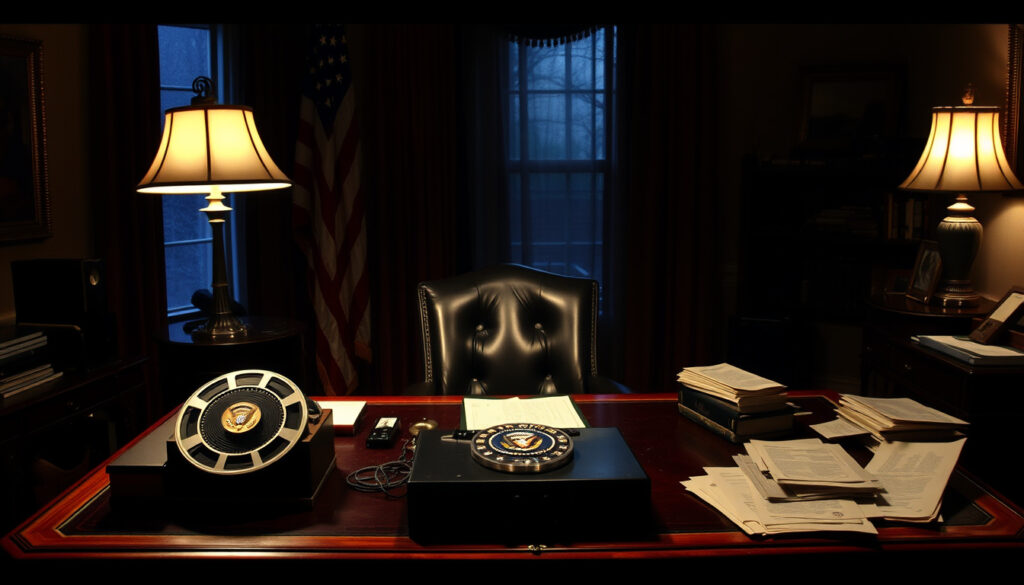
- Secretly recorded White House tapes—later subpoenaed by Congress and the Supreme Court—revealed Nixon’s involvement in the cover-up.
- The “Saturday Night Massacre” in October 1973 saw the firing of independent prosecutor Archibald Cox, sparking a constitutional crisis.
- Nixon resigned on August 9, 1974, after the House Judiciary Committee approved articles of impeachment.
- He was later pardoned by his successor, Gerald Ford, sparing him from potential criminal prosecution.
Snapshot facts
| Attribute | Detail |
|---|---|
| Full name | Richard Milhous Nixon |
| Born | January 9, 1913, Yorba Linda, California |
| Died | April 22, 1994, New York City, New York |
| Cause of death | Massive stroke |
| Presidency | 37th President, Republican, 1969–1974 |
| Vice President | Spiro Agnew (1969–1973), Gerald Ford (1973–1974) |
| Preceded by | Lyndon B. Johnson |
| Succeeded by | Gerald Ford |
What was Richard Nixon’s cause of death?
Nixon died on April 22, 1994, in New York City. According to the National Archives and other official sources, the cause was a massive stroke (cerebral vascular accident). He had been hospitalized days earlier after suffering a stroke at his home in Park Ridge, New Jersey.
In the years before his death, Nixon’s health had declined. He battled phlebitis and other age-related ailments. He was 81 years old at the time of his death.
While Nixon’s immediate cause of death was a stroke, some sources also note his long history of circulatory problems. The Whittier Museum and Britannica confirm the stroke as the primary cause.
How old was Nixon when he died?
Nixon was 81 years, 3 months, and 13 days old. He remains one of the longest-lived U.S. presidents.
Where did Nixon die?
He died at NewYork-Presbyterian Hospital in Manhattan. His body was returned to California for a state funeral and burial at the Nixon Library in Yorba Linda.
What did Richard Nixon do as president?
Nixon’s presidency (1969–1974) was marked by notable foreign policy achievements and domestic initiatives. He pursued a policy of détente with the Soviet Union and became the first U.S. president to visit the People’s Republic of China, a historic trip in February 1972 that reshaped geopolitics.
Foreign policy milestones
- Opening China: Nixon’s visit to Beijing ended decades of isolation and established diplomatic relations with China.
- Strategic Arms Limitation Talks (SALT I): Signed with the Soviet Union in May 1972, limiting nuclear arms.
- Vietnam War: Nixon pursued “Vietnamization”—gradually withdrawing U.S. forces while bolstering the South Vietnamese army. The Paris Peace Accords were signed in 1973.
Domestic policies
- Created the Environmental Protection Agency (EPA) in 1970.
- Signed the Clean Air Act and the Occupational Safety and Health Act (OSHA).
- Established the Supplemental Security Income (SSI) program.
- Implemented wage and price controls to combat inflation.
According to the Miller Center, Nixon’s domestic policy has been overshadowed by Watergate, but his environmental and social welfare reforms were far-reaching. The Encyclopaedia Britannica notes that Nixon’s foreign policy achievements were among the most significant of the Cold War.
Who was Nixon’s vice president?
Spiro Agnew served as vice president from 1969 until he resigned in October 1973 over a separate bribery scandal. Nixon then appointed Gerald Ford as vice president under the 25th Amendment. Ford later succeeded Nixon as president.
What was Richard Nixon’s early life and military career?
Nixon was born to Francis and Hannah Nixon in Yorba Linda, California, and raised in the nearby town of Whittier. He was the second of five sons. The family faced financial hardship, and two of his brothers—Harold and Arthur—died young.
Nixon attended Whittier College, a small Quaker school, and then went on to study law at Duke University School of Law, graduating in 1937. After a brief legal career in California, he married Thelma Catherine “Pat” Ryan in 1940.
World War II service
In 1942, Nixon joined the U.S. Navy as a lieutenant junior grade. He served in the Pacific Theater as an aviation ground officer and transportation officer, eventually rising to the rank of lieutenant commander. According to the U.S. Navy History and Heritage Command, he was stationed in the Solomon Islands and later in New Caledonia.
Political rise after the war
Nixon’s political career began in 1946 when he successfully ran for the House of Representatives. He gained national attention for his role in the Alger Hiss case. In 1950 he was elected to the Senate, and in 1952 Dwight D. Eisenhower chose him as his running mate. Nixon became vice president at age 40—one of the youngest in history.
He ran for president in 1960 but lost narrowly to John F. Kennedy. After a failed bid for governor of California in 1962, he moved to New York and practiced law. He made a remarkable political comeback in 1968, defeating Hubert Humphrey to win the presidency.
Key dates in Nixon’s life
- – Born in Yorba Linda, California
- – Graduated from Duke University School of Law
- – Served in the U.S. Navy during World War II
- – Elected to the U.S. House of Representatives
- – Elected to the U.S. Senate
- – Served as Vice President under Dwight D. Eisenhower
- – Elected President, defeating Hubert Humphrey
- – Historic visit to China
- – Watergate break-in
- – Saturday Night Massacre
- – Announced resignation; effective
- – Pardoned by President Gerald Ford
- – Died in New York City
What is clear and what remains debated about Nixon?
| Established information | Information that remains unclear |
|---|---|
| Nixon’s resignation was a direct consequence of the Watergate scandal. | The full extent of his knowledge of the break-in beforehand is still debated. |
| His cause of death was a massive stroke. | Some historians argue over the long-term impact of his domestic policies versus his foreign policy legacy. |
| He served as the 37th President of the United States. | Questions remain about the precise scope of his role in the cover-up even after the release of the tapes. |
How did Nixon’s presidency fit into the broader historical context?
Nixon’s time in office coincided with the height of the Cold War, the Vietnam War, and deep social divisions in the United States. His “Southern Strategy” helped realign the Republican Party by appealing to white voters in the South disaffected by civil rights policies.
The Watergate scandal fundamentally altered public trust in government and led to major reforms, including new campaign finance laws and the creation of the Office of the Independent Counsel. Nixon’s foreign policy achievements—especially the opening of China—had lasting geopolitical consequences, reshaping the global order for decades.
What do major sources say about Nixon?
“The finest hour of his presidency was the opening of China.”
— Nixon Presidential Library and Museum
“He was a complex figure whose legacy is both disgraced and accomplished.”
— Miller Center, University of Virginia
“Nixon’s political career was marked by both high achievement and deep controversy.”
— Encyclopaedia Britannica
What is Nixon’s lasting legacy?
Richard Nixon’s legacy remains deeply mixed. He is remembered for significant foreign policy accomplishments—including the opening of China and détente with the Soviet Union—and for important domestic reforms such as the creation of the EPA. Yet the Watergate scandal stains his reputation as a cautionary tale of unchecked executive power and abuse of trust. For more on global leadership, see Winston Churchill – Life, Leadership and Lasting Legacy and Jimmy Carter – President and Humanitarian Dies at 100.
Ongoing historical research and the continued declassification of Nixon’s White House tapes provide new insights. Scholarly reassessments of his domestic and foreign policies are published periodically, ensuring that the debate over his place in history continues.
Frequently asked questions about Richard Nixon
How old was Richard Nixon when he became president?
He was 56 years old when inaugurated on January 20, 1969.
Who was Richard Nixon’s vice president?
Spiro Agnew served from 1969 to 1973, then Gerald Ford from 1973 to 1974.
What did Richard Nixon do after resigning?
He retired to California, later moved to New Jersey, wrote several books, and served as an elder statesman advising later presidents.
Was Richard Nixon ever impeached?
No. He resigned before the full House could vote on articles of impeachment approved by the Judiciary Committee.
Did Richard Nixon serve in the military?
Yes, he served as a lieutenant commander in the U.S. Navy during World War II, stationed in the South Pacific.
What was Nixon’s “Southern Strategy”?
A political strategy to win support from white Southern voters by appealing to their discontent with federal civil rights initiatives.
How many terms did Nixon serve?
He served one full term (1969–1973) and part of a second term, resigning in August 1974.
Did Nixon have any pets in the White House?
Yes, the Nixons owned several pets, including a cocker spaniel named Checkers, famously mentioned in a 1952 speech.
More related posts
 Adrian Scarborough – The Character Actor Behind Iconic British Roles
 Edgar Wright – Movies, Biography, and Upcoming Projects
 Benjamin Zephaniah – Biography, Cause of Death, and Legacy
 Nicola Sturgeon – Biography, Memoir and Key Facts
 Catherine Parr – The Wife Who Survived Henry VIII
 Longest Bridge in the World – Record Length Maps and Facts
 The Prince of Egypt – Plot, Characters and Where to Watch